Brisket with Sweet-and-Sour Sauce

Adapted from The Essential New York Times Cookbook by Amanda Hesser (2021)

  • 1 large onion, quartered
  • 1 2-inch piece of fresh ginger, peeled
  • 6 large cloves garlic
  • 1/4 cup Dijon mustard
  • 1/2 cup dry red wine
  • 1 1/2 cups Coca Cola (regular – not diet)
  • 1 cup ketchup
  • 1/4 cup honey
  • 1/4 cup cider vinegar
  • 1/4 cup soy sauce
  • 1/2 cup olive oil
  • 1/4 teaspoon ground cloves
  • 1 tablespoon coarsely ground black peper, or to taste
  • One 6-7 pound first-cut brisket, rinsed and patted thoroughly dry.

Heat the oven to 350 degrees. Place all ingredients except the brisket in a food processor and process until smooth.

Place the brisket, fat-side-up, in a heavy roasting pan just large enough to hold it and pour the sauce over it. Cover tightly and bake for 2 hours.

Turn the brisket over and bake, uncovered, for 1 hour and check for tenderness. If it is fork-tender, you’re done! If not, cover loosely with foil and continue baking. Depending on the thickness of the brisket, this can take up to an additional hour. Keep checking every 20 minutes or so.

Once the brisket is done, take it out of the sauce and allow it to cool. Then wrap it in foil and refrigerate overnight. Pour the sauce into a container, cover it and refrigerate overnight.

The next day, transfer the brisket to a large cutting board and trim off the fat. Slice the brisket with a sharp knife against the grain. Remove any fat that has congealed on top of the sauce. Place the sliced brisket in a baking dish or roasting pan and pour the sauce over it, letting it run down between the slices.

At this point, you can reheat and serve using the instructions below. If you prefer to serve it later, wrap the whole thing in foil and freeze it or keep it in the refrigerator for a day or two until ready to heat and serve. If you decide to freeze it, thaw it in the refrigerator for about 24 hours before reheating.

When ready to serve, heat the oven to 350 degrees. Bake the brisket and sauce, covered, for about 30 minutes or until bubbly.

Serves 12
Easy Brisket

Adapted from Barefoot Contessa Parties! copyright 2001 by Ina Garten.

  • 5  pounds (or so) beef brisket, very well trimmed of fat
  • 6 medium yellow onions, peeled and sliced
  • 2 tablespoons kosher salt
  • 2 teaspoons freshly ground black pepper
  • 1 tablespoon minced garlic (4 cloves)
  • 2 teaspoons dried oregano leaves
  • 1 pound carrots, peeled and cut into 2-inch chunks
  • 8 stalks celery, cut into 2-inch chunks
  • 6 dried bay leaves
  • 1 (46-ounce) can tomato juice or low-sodium V8 juice.

Preheat the oven to 325° F.

Place half of the sliced onions in the bottom of a heavy roasting pan.  Place the brisket on top of the onions. In a small bowl, combine the salt, pepper, garlic, and oregano. Rub the mixture on the brisket. Pile the carrots, celery, remaining onions, and bay leaves on the brisket and pour in enough juice to come about 3/4 of the way up the meat and vegetables (in my roasting pan, that’s the whole can). Cover the top of the pan with 2 sheets of parchment paper, then with a sheet of heavy-duty aluminum foil.  Seal the edges well.

Bake for 4 hours, or until the meat is tender. Remove the meat from the pan and slice it against the grain. Remove the bay leaves and discard.  Put the vegetables, with sauce into a food processor with a steel blade.  Process until you get a chunky sauce.  Place the sliced meat in a 13×9 pan.  Pour in enough sauce to cover the meat.  There will be sauce left over that can be used for pasta or for use in other recipes.

At this point, you can refrigerate or freeze the brisket until ready to use.  (If you freeze it, thaw it overnight in the refrigerator before reheating.) When ready to serve, heat the brisket in a 325° oven for 30 – 45 minutes, until the meat is heated through and the sauce is bubbly.

Serves 6 people, with leftovers.

NOTE: We think this is even better when prepared ahead and frozen for future use.

Team Chiswitz Award-Winning Latkes

Want to cook latkes like the reigning champions of  the Congregation Shir Tikvah Latke Cookoff (2012)?  Just follow these instructions an amaze yourself!

  • 10 medium russet potatoes (about 4 pounds)
  • 2 medium yellow onions
  • 3 large or extra large eggs
  • 1/4 cup flour
  • salt and white pepper to taste
  • plenty of vegetable oil

First things first: If you have never fried latkes before, you need to know that, while they are delicious to eat, cooking them can make your house smell like oil and onions. For days. Take a few minutes before you start to make sure that nobody’s coat is hanging in the kitchen (unless you want to wash it), that closet doors are closed, and that you are wearing clothes that can be easily laundered. Also, be prepared for a thorough clean-up afterward.

OK, now you’re ready: Wash potatoes thoroughly.

Beat the eggs in a large mixing bowl.

Line a medium-sized mixing bowl with cheesecloth.

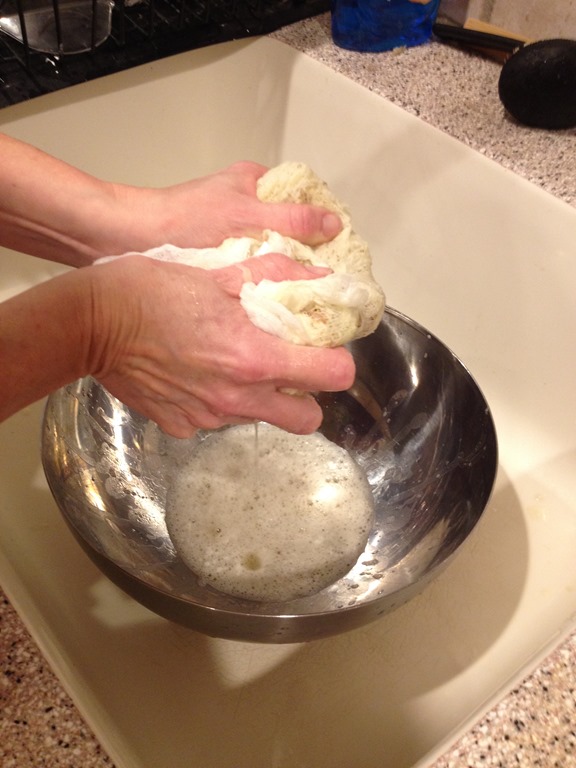
Using the grating blade of a food processor or a hand grater, grate potatoes and onions. It’s helpful to alternate them for easier mixing later. After you have grated a food-processor-bowlful, transfer grated potatoes/onions to the cheesecloth-lined bowl. Gather the cheesecloth up into a bundle. Twist the top to form a ball.  Squeeze as much liquid as you can from the potato/onion mixture.

IMG_0842

When no more liquid comes out, remove from cheesecloth and transfer to large bowl with eggs. Repeat with remaining onions and potatoes until all have been grated and squeezed. You may need to replace the cheesecloth.

Combine eggs with potato/onion mixture. It may be easiest to use your  hands here.

Sprinkle flour, salt and pepper over egg/potato mixture. Mix thoroughly to combine all ingredients.

Heat 1/2 – 3/4” of vegetable oil in a large skillet. We use an electric skillet set at 350 degrees, but a good skillet on the stove will do as well.  Our standard electric skillet uses about 22 ounces of oil per recipe. Drop a piece of potato into the oil. When it sizzles, the oil is ready.

Form potato mixture into patties and carefully place in oil. Fry to desired brownness, turn over and fry the other side. If you are going to be freezing the latkes, it’s a good idea to under-cook them a little, as they will get browner when they are reheated later.

Repeat until all of the batter is used up. No need to change oil between batches.

Transfer cooked latkes onto a plate lined with several layers of paper towel to drain. If serving right away, transfer to a serving plate and enjoy! They are delicious served with applesauce and/or sour cream on the side.

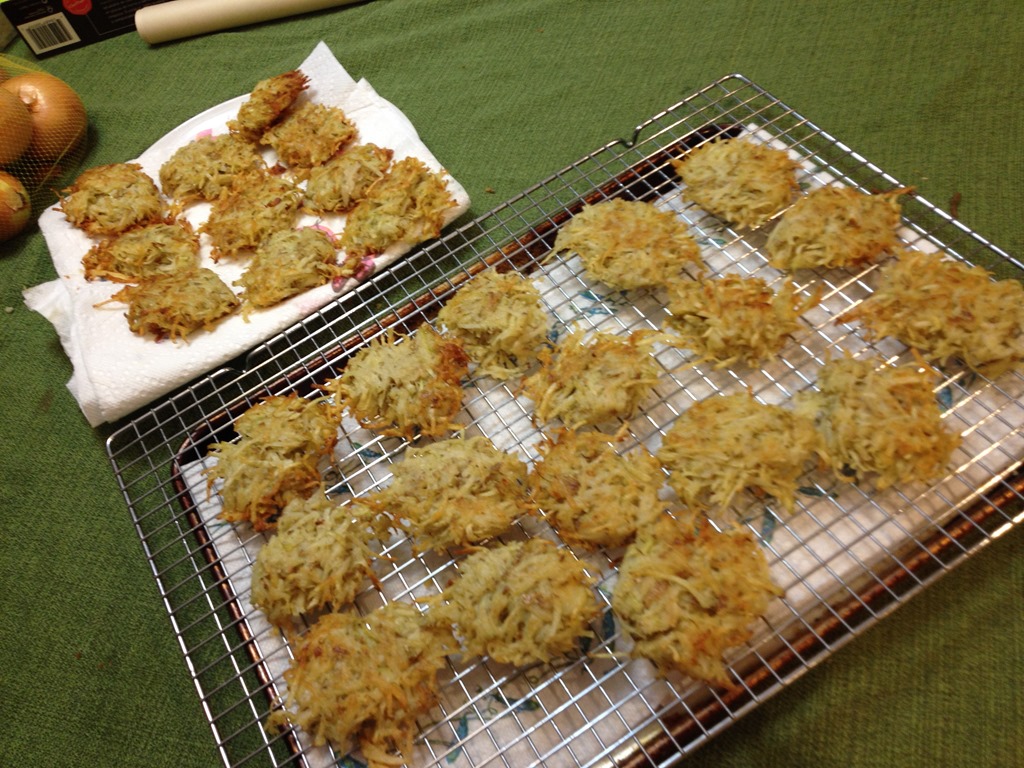
Freezing instructions:  Line two cookie sheets with paper towel. Set a cooling rack over each cookie sheet. When the latkes on the plate are cool enough to handle, transfer them to one of the racks. When they have cooled completely, transfer them to parchment-lined cookie sheets. It is OK to place two layers on a sheet, with parchment in between the layers. Cover tightly with aluminum foil and place them in the freezer. If you do not wish to store them on cookie sheets, they can be transferred to freezer bags or other containers once they are frozen solid. When it’s time to reheat, remove the foil, place latkes on a cookie sheet (if they aren’t already on one), let them sit out while you heat the oven to 450 degrees, then bake  for 8 minutes or so until hot and brown.

NOTE: Latkes do not keep very well in the refrigerator. If you are going to hang on to them, it’s best to freeze them.

IMG_0843Here are some latkes getting ready for the freezer. Note that they are slightly under-cooked.

Makes about 25 latkes.

I don’t recommend doubling the recipe, as it becomes difficult to handle and keep the potatoes in good shape. If you need more than 25 latkes, make additional recipes from the beginning, starting with fresh oil each time.

Rehfwitz Chicken Soup

  • 4-5 pounds chicken parts
  • Leaves and small stalks from the inside of 2 bunches of celery, plus 2-3 big celery stalks cut into 2” pieces
  • 6-8 carrots, (peeled if you will be using in soup, otherwise just washed well) and cut into 2” pieces
  • 2-3 parsnips, peeled and cut into 2” pieces
  • 2-3 onions peeled and quartered
  • 8 sprigs parsley
  • Some fresh dill (optional)
  • 1 Tbs. peppercorns
  • Kosher salt to taste

Cover chicken pieces with about 3 inches of water in large stock pot.  Bring to a boil over medium-high heat. As the water boils, scum will form. Skim it off and discard. This may take a while. Keep cooking until scum stops forming. The scum will not affect the flavor of the soup, but if not removed, it will make the broth cloudy. Add remaining ingredients; reduce heat and simmer, with the lid partially open, for 2 hours or so.

Remove chicken and vegetables and cool.

Strain stock using cheesecloth and refrigerate for at least 24 hours.

Skim fat from the top of broth and discard or save to use in other recipes like matzo balls.

Separate chicken from veggies, bones and skin. Chicken can be shredded and added back to soup or saved for another purpose. You may want to slice carrots and add them back to the soup if you will be reheating it right away. If the carrots are too mushy, or if you are planning to freeze the broth before using, discard them with the rest of the veggies, bones and skin.

When ready to reheat the soup, add salt to taste. You may also want to add fresh carrots and/or celery, noodles, kreplach, or matzo balls.

Simple Sweet Potatoes

From Andrea Suttles who brought them to Karen Schihl’s epic Margarita lunch.

  • 2 pounds sweet potatoes
  • 2 Tablespoons olive oil
  • 2 Tablespoons Honey
  • 1 teaspoon lemon juice
  • 1/2 teaspoon salt

Peel and cut the sweet potatoes into 1-inch chunks.  In a medium bowl, whisk together olive oil, honey, and lemon juice.  Throw in potato chunks and toss well.  Spray a jellyroll pan or pyrex dish with Pam and spread sweet potatoes out evenly.  Sprinkle with salt.  (I actually cover my pan with parchment or foil, so it’s easy clean up)

Bake at 350 degrees for about 1 hour, stirring once halfway through.

Makes about 4 1-cup servings.

Dijon Mustard Green Beans

Adapted from The Fruit of Her Hands, Published by Temple Israel’s Sisterhood of West Bloomfield, MI, 2009 Edition. 

  • 2 1/2 pounds green beans, ends trimmed
  • 1/4 cup olive oil
  • 1/2 cup light brown sugar
  • 3 Tablespoons Dijon mustard
  • 1 teaspoon dried tarragon or oregano
  • 2 teaspoons garlic powder or 1 clove minced fresh garlic
  • 1 Tablespoon kosher salt
  • Fresh pepper to taste

Preheat oven to 250 degrees.  Combine green beans, olive oil, brown sugar, mustard, tarragon or oregano, garlic, and salt in a large bowl and toss well.  The beans will be sugar coated; this will melt during cooking.  Transfer the beans to a large baking dish, cover with foil, and bake for 1 hour.  they will be tender-crisp.  toss the beans with the sauce that has accumulated at the bottom of the pan.  Transfer to a serving dish and season to taste with pepper.

Makes 12 servings.

Gefilte Fish

Stock

· 4 stalks celery, cut into 3-inch pieces

· 3 medium onions, sliced (onion skin may also be added to the stock for flavor and color)

· 6 medium carrots, peeled and sliced on the bias

· 14 cups water

· Fish bones (and heads, if using)

· 2 Tablespoons kosher salt

· 1 teaspoon ground black pepper

· 2 Tablespoons sugar

· A sprinkling of paprika

Fish

· 7 pounds ground fish (5 pounds whitefish and 2 pounds pickerel, or similar)

· 2 medium onions, very finely chopped in the food processor

· 2 Tablespoons kosher salt

· 5-6 eggs, lightly beaten (Start with 5 and be ready to add another one later to achieve the right consistency.)

· 2 Tablespoons sugar

· ¾ – 1 cup Matzo meal (I measure out a cup and add gradually until correct consistency is reached.)

· ¾ cup water

· 1 teaspoon ground black pepper

· 2 medium carrots, finely grated

Put stock ingredients in a very large pot. Bring the stock to a boil while you prepare the fish. Reduce heat and let the stock simmer while you finish.

In a large bowl, preferably made of wood, add the fish and the remaining ingredients on the “Fish” list, stirring and chopping with a hand chopper as you go. Keep blending and chopping until the desired consistency is reached and there are no large chunks of fish, onion, or carrot. The mixture should hold together, but still be moist. Your arm will probably get sore.

With wet hands, form the fish into fat, oval-shaped patties. The end of a largish wooden spoon is useful for this, and keeps the size relatively uniform. Slide each patty carefully into the simmering stock.  NOTE:  Don’t crowd the fish balls; they will swell during cooking.

Cook slowly for about 2 hours. Allow fish to cool in pot for about 30 minutes, then transfer to a container. Strain the broth. Remove and save carrots for garnish. Discard other veggies and fish parts. Pour the strained broth over the fish. Store the fish and broth in a covered container in the refrigerator. It is best when made 2-3 days ahead.

Pineapple Upside Down Kugel

Submitted by Beth Isola

  • 1 lb medium noodles
  • 3 eggs beaten
  • 1/2 pint sour cream
  • 1/2 cup melted butter
  • 1 tsp. salt
  • 1 tsp. vanilla
  • 2 cans sliced pineapple (you’ll need enough slices to cover the bottom of a 9×13″ pan)
  • 1 1/2 cups brown sugar (either light or dark, whichever you prefer)
  • Marachino cherries — enough to place one inside each pineapple slice

Cook noodles in salted water, drain and cool.

Add eggs, sour cream, butter, salt and vanilla to cooked noodles.  Mix well.

Prepare 9×13″ pan by buttering well.

Sprinkle brown sugar on bottom of pan.

Arrange pineapple slices over sugar.  Put one cherry in center of each pineapple slice.

Pour noodle mixture in pan.

Bake at 350 for one hour.

Invert immediately onto serving platter.

Enjoy!

Can be frozen and reheated at serving time.